
The Mystery of Fan Nichols
The biography of 20th Century romance and noir author Fan Nichols. This post is a research project that is still under investigation.
AUTHOR INFORMATION
William Gould
12/26/20255 min read
If you collect vintage paperbacks, you may know the name Fan Nichols. Her covers, often gracing titles like Possess Me Not, Ask for Linda, and The Loner, are staples of the mid-century spinner rack. But if you try to find the woman behind the typewriter, you hit a wall.
Who was Fan Nichols? Where did she go? How could a woman who sold an estimated two-to-three million books simply disappear?
I'm not a professional genealogist or researcher. I am a vintage paperback collector, restorer, and a fiction lover who believes that Fan Nichols’ voice deserves to be revisited. To be honest, I’ve become a bit obsessed with her work and with trying to learn who she was. I have been searching online, digging into public records, copyright renewals, and the introductions of her own books to piece together her story. I’ve even engaged my favorite mother-in-law, an experienced genealogy researcher, to begin building out Fan’s story.
What I’m discovering contradicts the little information currently available on the internet. My research and this biography is a work in progress, and I am sharing what I know in the hopes that others can help me solve the mystery of Fan Nichols.
The Death of Fan Nichols (and why it's wrong)
If you look up Fan Nichols online, you will likely see several possible death dates listed, as early as 1966. However, my research into the Catalog of Copyright Entries tells a different story.
All of Fan Nichols’ novels were published before 1964. Why is this relevant? Because the copyright laws in the United States changed in 1964. For works originally published between 1929 and 1963, the original copyright lasted for twenty-eight (28) years; copyright holders could renew their copyright for an additional sixty-seven (67) years.
Fan Nichols personally renewed many of her copyrights. The latest renewal, the copyright for her novel Be Silent, Love was filed on December 20, 1988. Because she is listed as the author and the claimant in this copyright renewal, she had to have lived until at least the end of 1988.
From Concert Pianist to "Real Realism"
Fan Nichols was born Frances E. Nichols on May 15, 1907 in Lake, South Dakota; her family referred to her as Fannie. Her mother had ambitions for her to become a concert pianist. Fan spent hours practicing and even performed concerts on the West Coast, but she later claimed that while she played the piano, "her heart belonged to writing”.
According the the 1910 US Census, when she was 3, Fan lived in Burleigh, ND with her father Calvin W. Nichols (Age 45), her mother Dalia Nichols (Age 38), her sister Hazel (Age 17) and her sister Ruth (Age 13). The 1920 Census showed Fan was still in North Dakota and living with both her her parents; her sisters were not listed, grown then and likely on their own, and her grandmother had moved in.
Fannie Nichols is included in a 1918 newspaper article in The Bismarck Tribune, “Second Dramatic Club Program Nets Red Cross The Sum Of $7.45.” Fannie played a sister in the production of Bluebeard.
Sometime between 1920 and 1924, Fan had moved to Oregon with her parents. The 1930 US Census had Calvin and Delia Nichols living in Oregon. Calvin’s profession is listed as “tailor” in both documents (1920 and 1930) and he appeared to own his own business.
Before she found success as an author, Fan lived a life that sounds like one of her own characters. She worked as a model, a stenographer, and a cosmetologist. My research suggests she may have married three times in Oregon between 1924 and 1935—first to Lyle McCutcheon in 1924 (at age 17, likely lying about her age), then to George E. Robinson (1928), and finally to Hugh Hanna in 1935 (some of her early novels were published under the name Frances Hanna). It seems that Fan was abandoned by Lyle, and Hugh was granted an uncontested divorce in 1937 for “cruelty.” This record is not yet definitive; it appears that Fan used several names and although stringing the records together strongly supports this is the same woman and the author, more research needs to be done.
The New York Connection: The Content Years
Following her divorce from Hugh Hanna in 1937, Fan moved east. I have located a New York voter registration for a Frances E. Content. It appears there was a fourth marriage to a Harold A. Content, a war veteran and prominent Assistant US Attorney in New York, who died in 1944. In 1953, Fan published Hideaway under the pseudonym Nikki Content.
By the 1950s, she had remarried again (likely her fifth marriage), this time to an artist, which is disclosed in the introduction to the 1960 paperback reprint by Ace, The Girl in the Death Seat. According to the introduction, she divided her time between a New York apartment and a beach home on Fire Island. She claimed to have traveled through the US, Canada, and Mexico, always accompanied by a portable typewriter.
The Mystery of the Missing Novels
According to the author biographies printed in her own books, Fan Nichols was incredibly prolific.
The intro to He Walks by Night (1957) claims she had 15 novels published.
Love Me Now (1958) bumps that number to 19 novels.
By the time Ask for Linda was reprinted in 1959, the intro claimed she had 30 novels published.
However, under the names we know—Fan Nichols, Frances Hanna, and Nikki Content—I can only verify 19 original novels (excluding reprints).
Was this just marketing hyperbole from publishers trying to make her sound like a bigger star? Or are there dozens of Fan Nichols books out there hiding under different, unknown pseudonyms?
A Partial Bibliography
Here is a timeline of her known works based on my current research:
1938: Deadline for Lovers (as Frances Hanna; Godwin)
1938: Stay Out of My Parlor (as Frances Hanna; Arcadia House)
1939: Cupid Misbehaves (as Frances Hanna; Arcadia House)
1940: Andrea Moves In (as Frances Hanna; Arcadia House)
1950: Pawn (Beacon Books – her first paperback original)
1950: Scandalous Lady (Beacon Books)
1951: Scandal (Woodford Press)
1951: Possess Me Not (Avon; reprinted again by Avon in 1952 as The Caged)
1951: One By One (Arco; later reprinted by Popular Library as Dolly)
1953: Hideaway (Gold Medal; as Nikki Content)
1953: Ask for Linda (Popular Library)
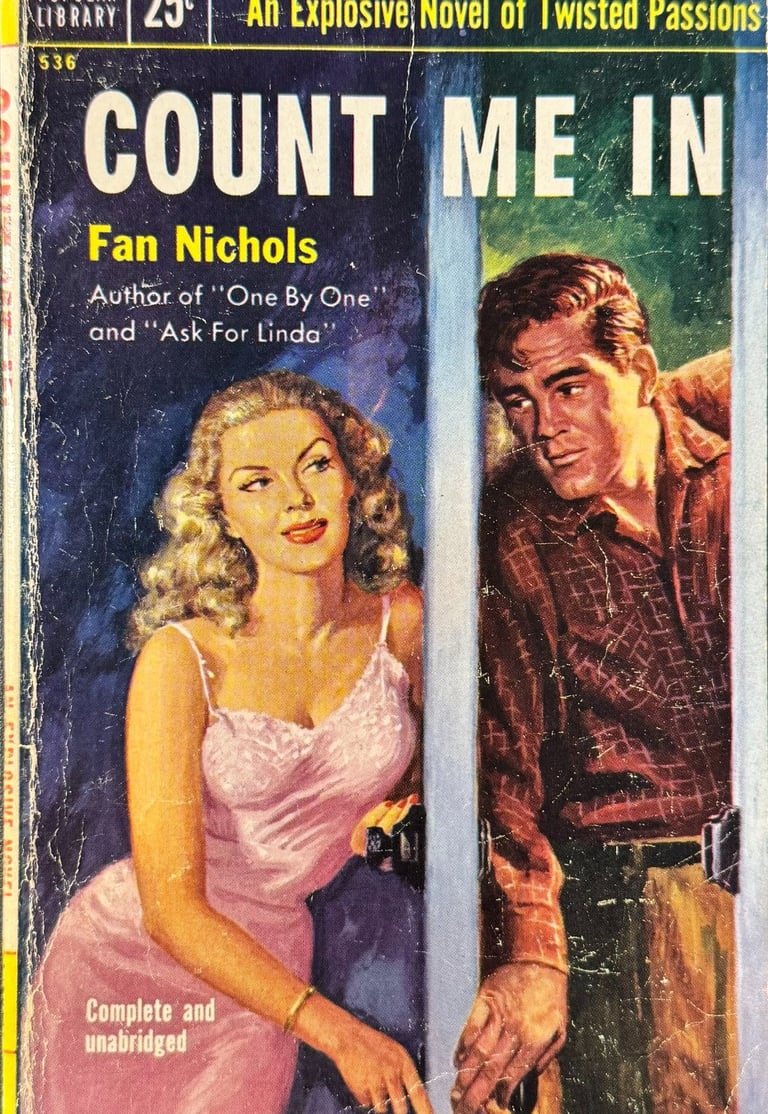
1953: Count Me In (Popular Library)
1953: Devil Take Her (Popular Library)
1955: Angel Face (Popular Library; reprinted by MacFadden in 1970)
1955: I’ll Never Let You Go (Popular Library)
1956: The Loner (Simon & Schuster; later reprinted by Popular Library as He Walks By Night)
1958: Love Me Now (Monarch Books)
1958: I Know My Love (Expanded from story in Bachelor Magazine)
1960: Be Silent, Love (Simon & Schuster; later reprinted by Ace as The Girl in the Death Seat)
Can You Help Me Solve the Mystery?
There is still so much to learn. When did she die? Do any family members or possible descendants hold her archives? What are the “missing” novels referenced in her bios?
I am building a centralized archive of information on Fan Nichols to ensure her work isn't lost to time. If you have information, old clippings, author information in her publications, or insights into her life, please reach out to me at bill@gouldpress.com.
Fan Nichols wanted to write because she wanted to live. It’s time we help keep her story alive.
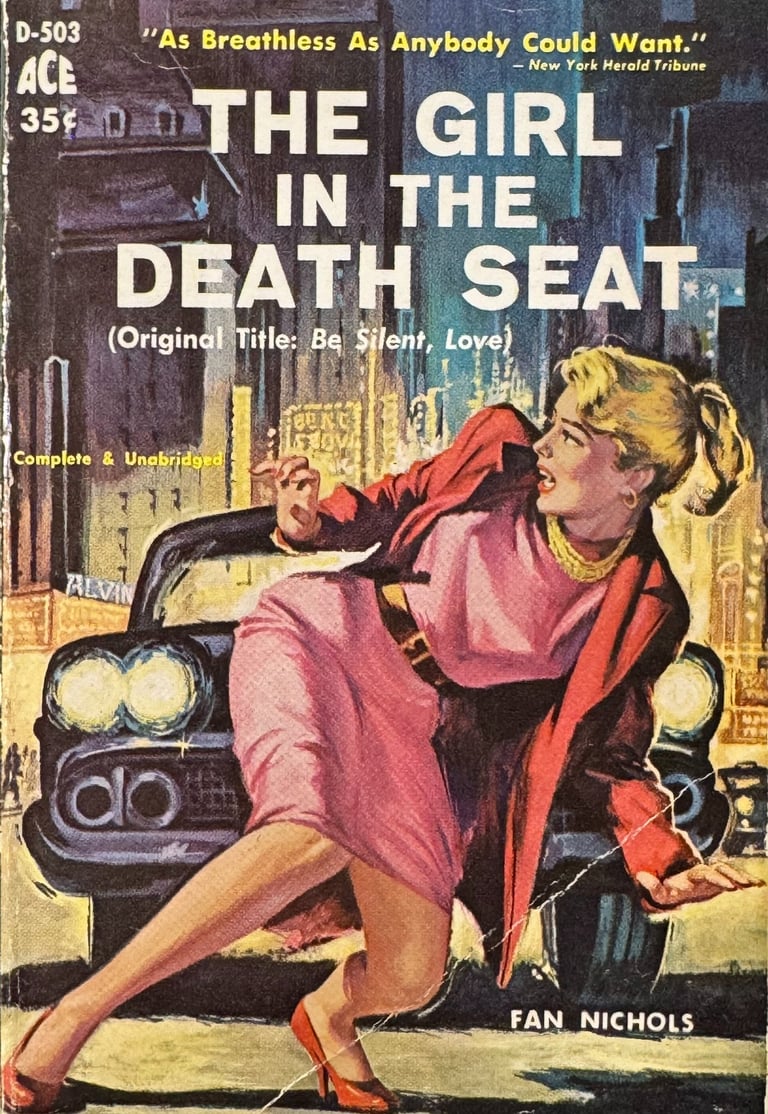
The Girl in the Death Seat, Fan Nichols - Ace Books (D-503), 1960.
Count Me In, Fan Nichols - Popular Library (536), 1953.